


Article
Cobalt – what’s it all about?
We often talk about cobalt being important for growth and cobalt deficiency being a common cause of ‘ill-thrift’ in lambs and growing cattle. However, cobalt is an essential trace element for all classes of ruminant stock, and the impacts of sub-optimal supply can be much more widespread.
The importance of cobalt and vitamin B12 for ruminants
Cobalt has one known function in the ruminant body, which is for the production of Vitamin B12 by the rumen microbes, this means the impacts of a cobalt deficiency actually result from a lack of vitamin B12. As there is virtually none present in plants, microbial synthesis using cobalt is the sole source of vitamin B12 for ruminants.
Vitamin B12 functions in two major metabolic pathways. The first being ‘gluconeogenesis’ which is the production of glucose from other compounds including volatile fatty acids produced during rumen fermentation, body fat and protein stores. All cells require glucose as a vital energy source, however the process of rumen fermentation means cattle and sheep absorb little glucose from their diet, making this pathway particularly important.
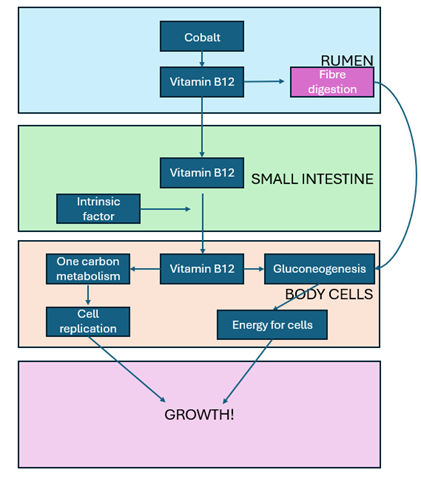
The second pathway vitamin B12 is essential for is known as ‘one carbon metabolism’. Normal functioning of this pathway is central to cellular function, cell replication and red blood cell production. This pathway is also essential for fibre digestion by the rumen microbes; this can be limited when cobalt/vitamin B12 is lacking with knock-on effects on feed intake, feed utilisation and growth performance. The diagram below outlines the metabolic pathways cobalt/vitamin B12 is involved in and how these contribute to growth performance in ruminant animals.
It’s important to remember that in addition to limiting growth, a lack of cobalt/vitamin B12 leading to improper functioning of these pathways can also impact body condition, fertility, milk yield, immune system functioning, wool/coat condition and oxygen transport (anaemia), as all these systems rely on a consistent supply of energy for cells. Sheep are more susceptible to deficiency than cattle as they have a poorer ability to absorb vitamin B12. Clinical signs of cobalt/ vitamin B12 deficiency, collectively referred to as ‘pine’, are most commonly observed in newly weaned and growing stock for the following reasons.
>Higher cobalt/Vit B12 requirements for growth
>Rumen not fully developed, meaning less production of Vitamin B12
>Limited body reserves of vitamin B12
>Parasitic challenge can reduce vitamin B12 absorption
Signs of cobalt deficiency or ‘pine’
>Reduced appetite
>Poor growth and body condition
>Ill-thrift and lethargy
>Anaemia
>Weepy eyes
>Poor wool/coat condition
>Increased incidence of infectious diseases
Requirement for cobalt/ vitamin B12 supplementation
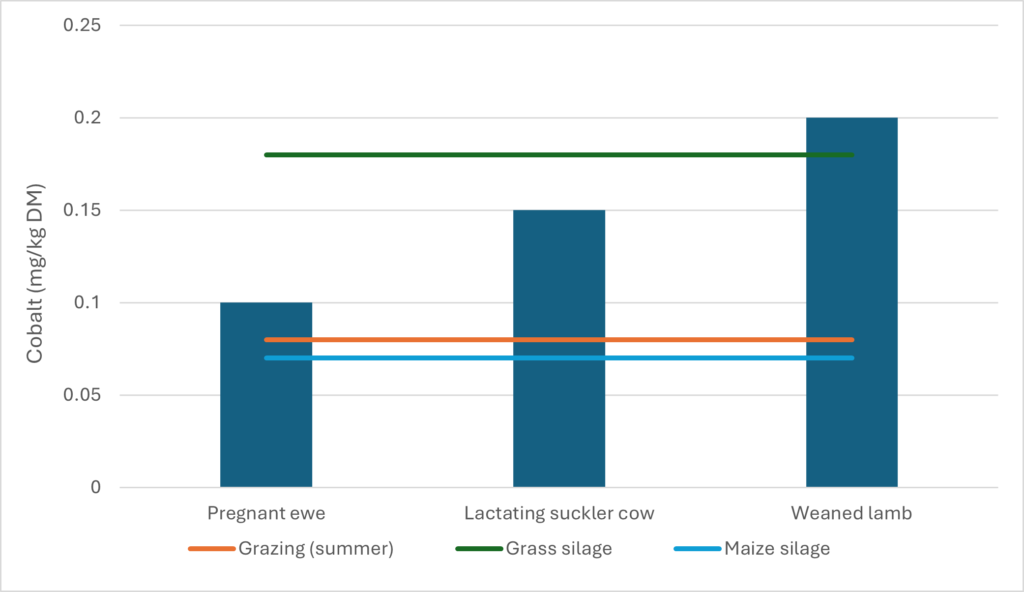
So, we’ve established the importance of ensuring correct supply of cobalt/vitamin B12, but why and when may supplementation be required? Firstly, we know that cobalt levels in UK grazing, forages and cereals often fail to meet ruminant requirements, particularly for growing and lactating stock which have higher cobalt requirements (0.2mg/kg DM) than stock at maintenance (0.1mg/kg DM). We also see a seasonal ‘dip’ in pasture cobalt levels during the summer as cobalt is less available for uptake by plants when soils are dry. This leaves newly weaned lambs particularly vulnerable to deficiency.
Supplementation options
Whether supplemental cobalt, vitamin B12 or a combination is required will depend on the age of stock, level of production and method of supplementation. In severe cases of deficiency, or where there have been historical problems, a vitamin B12 injection can be given. In less severe cases and to prevent deficiency, oral supplementation by ‘direct’ (drench/bolus) or ‘indirect’ (free-access) methods can be highly effective. Newly weaned lambs and calves will benefit from both cobalt and vitamin B12 as the rumen may not be fully developed. However, once the rumen is established, the majority of supplemental B12 will be degraded by the rumen microbes, therefore supplying cobalt only is more suitable for adult ruminants.
| Method of cobalt/ B12 supplementation | Benefits | Considerations | |
| Vitamin B12 injection | B12 | Every animal receives the supplement Quickly increases blood B12 levels Highly effective | Costly, labour intensive, requires prescription |
| Oral bolus | Cobalt | Long lasting supply Consistent release of cobalt Every animal receives the supplement | Costly, risk of regurgitation, supplies limited number of nutrients |
| Oral drench | Cobalt and B12 | Relatively low cost Every animal receives the supplement Combination of cobalt and B12 benefits newly weaned stock | Labour intensive, repeated applications required, supplies limited number of nutrients |
| Powdered minerals (in-feed or free-access) | Cobalt (B12 optional) | Relatively low-cost. Flexible formulations to specific farm requirements | Free-access applications, potential variation in intakes. In-feed limited to housed stock |
| Feed blocks & mineral buckets | Cobalt (B12 optional) | Low cost and easy to use. Can also supply energy, protein macrominerals (e.g. calcium) and other functional ingredients 24/7 availability | Potential variation in intakes |
Leave a Reply