


Article
Research Supports the Value of Feed Block Supplementation in Sheep Systems
Efficient feed block supplementation remains one of the biggest nutritional challenges in grazing sheep systems. While mineral and feed supplements are widely used to support flock performance, variation in individual animal intake can make it difficult for producers to ensure nutrients are being delivered consistently across the flock.
Recent Australian research investigating sheep behaviour at lick and loose-lick feeders has provided valuable insight into how sheep interact with self-fed supplement systems and how monitoring technology may help improve supplementation management in commercial grazing environments.
How Sheep Interact With Self-Fed Supplement Systems
The study evaluated sheep attendance and feeding behaviour at two different supplement systems:
· Lick feeders delivering pelleted supplements
· Loose-lick feeders delivering coarse salt
Researchers monitored 180 Merino ewe lambs using advanced RFID (radio frequency identification) technology fitted to commercial feeders. Both low-frequency (LF) and ultra-high frequency (UHF) RFID systems were used to record how often sheep visited feeders and how much time they spent consuming supplements.
One of the key findings was the strong relationship between feeder attendance and time spent feeding. Sheep that visited feeders more frequently generally spent more time consuming supplements. This relationship was particularly strong in pellet-feeding systems, suggesting feeder attendance may provide a practical indicator of supplement consumption behaviour within grazing flocks.
Importantly, the study also highlighted substantial differences between individual animals. While some sheep regularly visited feeders and consumed supplements consistently, others visited more frequently but spent less time feeding. Researchers suggested these behavioural differences may reflect social hierarchy, feeder competition, or individual feeding patterns within the flock.
Why Intake Consistency Matters
This reinforces a long-recognised challenge in sheep nutrition — supplement intake is rarely completely uniform across all animals.
For producers using mineral buckets, feed blocks, lick feeders, or loose mineral systems, these findings underline the importance of:
· Palatability
· Feeder accessibility
· Flock management
· Consistent supplement availability
The study also reinforced the broader value of self-fed supplementation systems within grazing enterprises. Feed blocks, lick feeders, and loose-lick systems allow sheep to access nutrients gradually according to their physiological requirements while reducing labour input and handling stress.
The Benefits of Self-Fed Supplementation During Key Production Periods
This style of supplementation is particularly valuable during periods of increased nutritional demand, including:
· Pre-tupping
· Late pregnancy
· Early lactation
· Seasonal pasture decline
UCD Trial: Uniblock Feed Block Supplementation Buckets in Practice
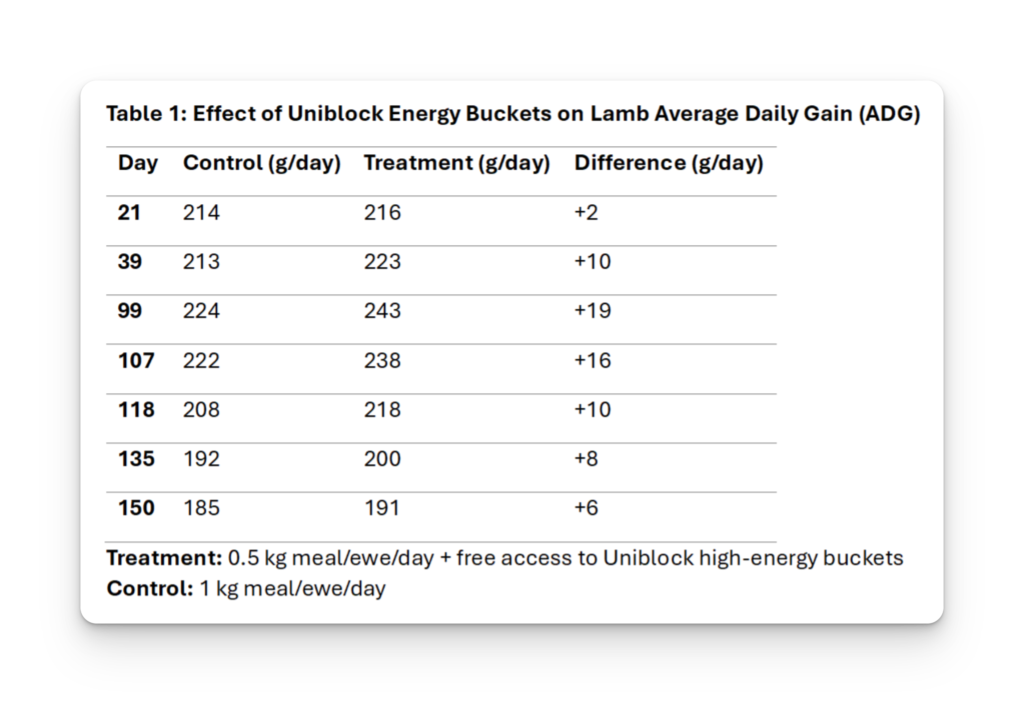
At Uniblock, this principle forms the basis of our nutritional approach. Research carried out with University College Dublin (UCD) demonstrated the practical benefits of feeding Uniblock high-energy buckets to ewes after lambing.
The UCD trial evaluated 24 ewes with triplets at foot during the spring lambing period. The ewes were divided into two feeding treatments:
· 1 kg meal/ewe/day (control)
· 0.5 kg meal/ewe/day combined with free access to Uniblock high-energy buckets.
The ewes receiving Uniblock buckets consumed an average of 135 g/ewe/day from the buckets over the six-week trial period.
Results showed measurable benefits for both ewe condition and lamb performance.
At lambing, body condition scores were similar between the groups:
· Control: 2.9
· Treatment: 3.0
By Day 37 after lambing, both groups averaged a body condition score of 2.6. However, by Day 99 after lambing, ewes receiving Uniblock supplementation had recovered to an average body condition score of 3.0 compared with 2.8 in the control group.
The greatest improvement was observed between Day 37 and Day 99 after lambing:
· Control ewes improved body condition score by 0.24
· Supplemented ewes improved by 0.46.
Lamb performance also improved throughout the trial. Lambs from ewes receiving Uniblock supplementation consistently achieved higher average daily liveweight gains across multiple stages of lactation.
What the Results Mean for Your Flock
These results demonstrate the importance of providing additional energy and protein support during lactation, particularly for ewes rearing triplets or twins. Improved ewe recovery and stronger lamb growth during early life can have significant impacts on flock productivity, lamb finishing performance, and overall system efficiency.
The trial also highlighted several practical advantages of bucket supplementation:
· Improved energy and protein supply during lactation
· Support for milk production
· Reduced labour requirements
· Flexible self-regulated intake
· Reduced mismothering compared with concentrate feeding in the field
The Uniblock energy buckets used in the trial supplied protected energy and protein sources, alongside magnesium and a full range of trace elements to support ewe health and productivity.
Together, both the Australian RFID research and the UCD Uniblock trial reinforce the growing value of practical self-fed supplementation systems within sheep production. Feed blocks and energy buckets not only offer a labour-efficient method of nutrient delivery, but also help provide continuous nutritional support during the most demanding stages of the production cycle.
As sheep enterprises continue to focus on flock performance, labour efficiency, and nutritional precision, practical supplementation systems supported by ongoing research are likely to play an increasingly important role in improving ewe performance, lamb growth, and overall flock productivity.